You have to be pretty good at your job as an editor and sound designer for Roger Ebert to call you “the most respected film editor and sound designer in the modern cinema.” But the reputation of Walter Murch as one of the greatest editors of all time is absolutely earned and true. Not only has he received three Academy Awards for best editing (with nine nominations in total), but he’s also been hugely influential in film editing function and theory.
Famous for working on classic films like Apocalypse Now, The Godfather I, II, and III, The Conversation, and The English Patient (as well as for editing all his films while standing for increased creativity),
In his book, In the Blink of an Eye, Walter Murch details The Rule of Six, discussing the six categories that make for a great cut.
The Rule of 6
The tenets are basically this:
- Emotion
- Story
- Rhythm
- Direction of the audience’s sight
- Bi-dimensional space of the screen
- Tri-dimensional space of the action
“The ideal cut is one that satisfies all the following six criteria at once.”
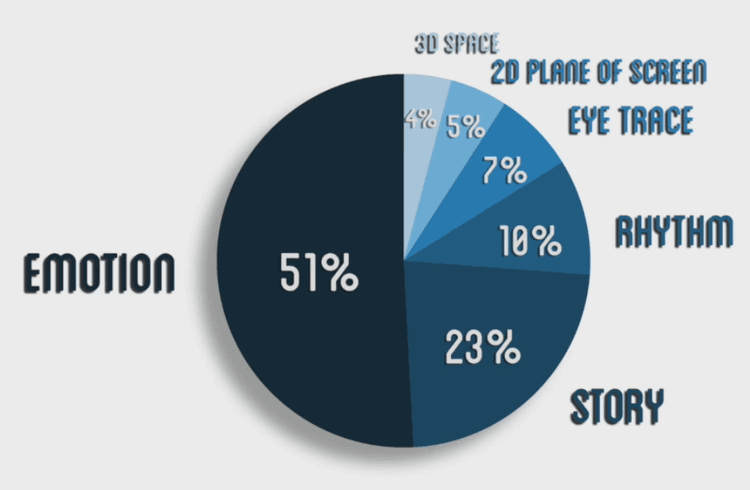
What I’m suggesting is a list of priorities. If you have to give up something, don’t ever give up emotion before story. Don’t give up story before rhythm, don’t give up rhythm before eye-trace, don’t give up eye-trace before planarity, and don’t give up planarity before spatial continuity.
Murch’s explanations below further outlines the thoughts behind these criteria, as well as proposed questions you can ask yourself when cutting films or projects of your own. These criteria and questions should be addressed hierarchically as you work your way down the list.
- Did the transition from one shot to the next make you feel a certain way?
- Did that cut help you to understand the story?
- Did it happen at the right place rhythmically?
- Where is the eye of the audience likely to be looking?
- Are we convinced that person A is looking at person B?
- Does the cut follow the continuity of the three-dimensional reality of the space?
Do you sometimes struggle to know when your cuts in your video edits are actually “working”? Perhaps you are new to video editing and have not yet developed that editing “gut feel” more experienced editors are always going on about. We’ve got an inside scoop that can help you with this conundrum, and it is called “the Rule of Six”.
While it is true that video editing is a technical vocation, editing itself is actually less about tools and more about story. In order to become a more intentional editor, you need to start thinking critically about your shots, their order, when you choose to cut and other factors that impact your storytelling.
Today we will introduce you to some of the historical schools of thought regarding editing theory so you can start making more considered editing decisions. Mainly, we are going to focus on Walter Murch and his theory regarding the Rule of Six. Finally, we’ll wrap things up by talking about deductive versus inductive storytelling, which will help you decide how you should open your videos.
WALTER MURCH & THE RULE OF SIX
Let’s dive into Walter Murch and the Rule of Six. Firstly, who is Walter Murch? Walter Murch is an Academy Award-winning editor, and he’s best known for films, such as Jarhead, The English Patient, Apocalypse Now, The Unbearable Lightness of Being and The Talented Mr. Ripley.
Walter Murch gave a seminar for editors that was turned into a book called In the Blink of An Eye. It’s one of the most highly regarded pieces on editing and is filled with incredible nuggets of very practical and very technical advice rather than very overarching, high-level theory, which can sometimes be unnecessarily complicated and not practical enough for real-world editors who need some down-to-earth advice on how to make their edits work.
The Rule of Six is one of Walter’s principles from In the Blink of An Eye. It came about as a response to a question asked by one of the editors in the audience. This particular editor wanted to know something along the lines of, “How do I know if my cuts are effective in my edit?”
Walter’s response was that every cut that you make should satisfy six criteria, but that these criteria aren’t all equally as important as each other. Let’s break it down a little bit more.
#1 EMOTION: 51% IMPORTANCE
First up, we have emotion with a 51% importance weighting. Here are some questions that you can ask yourself while you are editing to know if your cuts are making sense emotionally.
- Are your cuts working for the right emotional tone or feel for what you are going for overall?
- How will this cut affect the audience emotionally at this moment?
#2 STORY: 23% IMPORTANCE
Next up, he gave a 23% weighting of importance to story. The question that you can ask yourself while you are editing is…
- Does the cut, transition or edit advance the story in a meaningful way?
If it doesn’t, you’re probably better off not making a cut or not using that transition at that given point.
#3 RHYTHM: 10% IMPORTANCE
Rhythm comes in next with a weighting of 10% importance. Ask yourself the following question:
- Is the cut making rhythmic sense to support the emotion of the story at this point in time?
Remember, of course, that rhythm is pace. In other words, how long, or how short, how fast or how slow your shots and sequence of shots are.
#4 EYE TRACE: 7% IMPORTANCE
Then we have eye trace with a weighting of 7% in importance. You’ll remember eye trace from our earlier discussion about continuity editing. The questions that you can ask yourself in this instance include:
- Where is the eye of the audience likely to be looking before I make this cut?
- How does this cut affect the movement of the audience’s focus?
#5 2D PLANE OF SCREEN: 5% IMPORTANCE
Second from last with a 5% weighting of importance, we have 2D plane of screen. This refers to the 180-Degree Rule that we discussed when we spoke about continuity editing. Questions that you can ask yourself in this instance are:
- Do the cuts maintain the line?
- And if the intention is to cross the line, is it effective? In other words, is it noticeable enough for the audience to pay attention?
#6 3D SPACE: 4% IMPORTANCE
And lastly, with a 4% importance weighting, we have 3D space. This basically refers to the entire process of ensuring that your viewer is oriented in the 3D space that is being portrayed as 2D on the screen. The question that you can ask yourself in this particular scenario is:
- Did the cut establish the subject’s physical space well enough so the audience understands how they arrived and where they are now?